





supercritical
Home / supercritical
Unlock superior extraction capabilities with our cutting-edge supercritical technology, designed for precision, efficiency, and sustainability across diverse industries
supercritical Categories

1. Core Separations, USA
Core Separations
Supercritical Fluid Extraction System
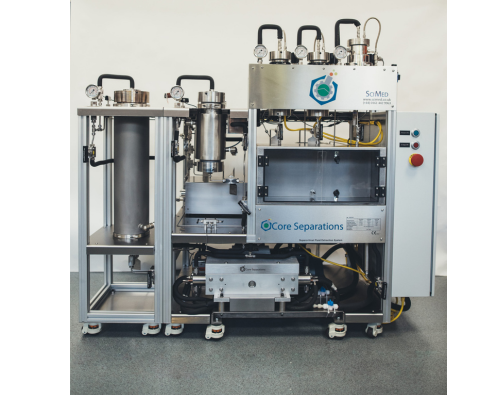
Model: Supercritical Fluid Extraction System
Core | Extraction systems offer unparalleled control in the extraction and isolation of a diverse range of
natural products.
Supercritical Fluid (SCF) extraction systems that harness true power of carbon dioxide as a solvent. Product solubility, physical make-up of raw material and most importantly, mass of CO2 per mass of raw material, pressure and temperature are critical to extraction efficiency and operating costs. These system related factors are optimized in our extraction systems to realize full benefits of CO2 processing – safe, organic and very cost-effective extracts. All the systems are manufactured under stringent quality conditions complying to ASME guidelines.
Lab and pilot-scale SCF extraction systems for processing botanicals, natural products, polymers and other fine chemicals.
- Lab-scale extraction systems in 100 mL, 500 mL, 1L, 5L and 10 L extraction vessel volumes Additional extractor volumes, flow, pressure, temperature and fractionation options are available to customize extraction systems to your needs.Reaction, RESS and SAS systems are also available for research and application with Method development.
- Pilot-plant range offered with single or multiple vessels for batch and semi-continuous operations from Kilos to hundreds of Kilos of material processing. Systems in standard or custom to your application are available in 2x5L, 2x25L, 2x50L, 2x75L and 2x100L sizes
- Application :
- Extraction & Fractionation of edible fats & oils
- Purification of solid matrices
- Separation of tocopherols & other anti-oxidants
- Cleanup of herbal medicines & food products from pesticides & herbicides
- Detoxification of shellfish
- Concentration of fermentation broth, fruit juices, etc
- Flavors, spice extracts, herbs, decaffeination
- Fragrances
- Natural Food colors
- Desolvation within tablets
- Dietary supplements such as St. John’s Wort, saw palmetto, kava-kava, ginger, garlic and ginseng
- Production of denicotined tobacco
- Production of active ingredients from herbal plants for avoiding thermos or chemical degradation
- Active compounds of all kinds, including steroids and polymer / monomer separation
- Precision parts cleaning
Core Separations
Schematic of SFE System
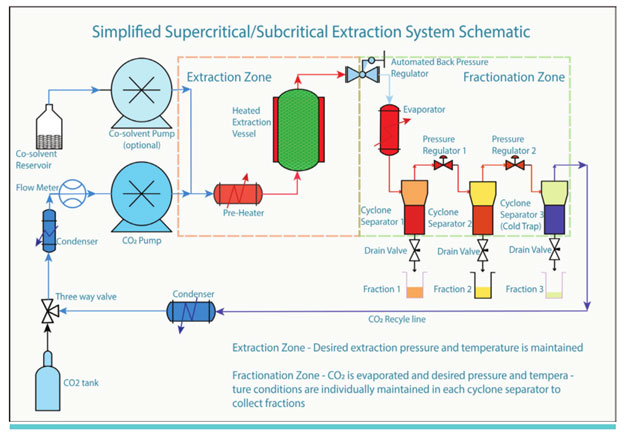
Schematic of SFE System
- Our material focused systems encompass a diverse range of processing capabilities. Utilizing CO2 to perform, particle formation (RESS, SAS and GAS), part cleaning, sterilization and dying applications.
- RESS Module
- A RESS module comprising of following parts in conjunction with system. Using a non-stirred vessel will be used to allow RESS operation in the SFE system.
Specifications :
- RESS particle formation vessel: 1
- Volume: 100 mL
- Pressure: up to 5 bar
- Temperature: Ambient
- Heated Nozzle Assembly with following nozzle discs: 10, 25, 50 and 100 micron sizes
- Dissolution vessel: Extraction vessel from SFE system
- Safety device on particle formation vessel
SAS Module
- A SAS module comprising of following parts in conjunction with system from SFE will be used to allow SAS operation in the SFE system. Co-solvent pump option has to be selected for SAS module option to work.
SF Dyeing
- “The use of CO2 for dyeing both natural and synthetic fibers produce an exceptional even coating often superior to aqueous methods.”
- CO2 is applicable in various drying processes, including but not limited to aerogel production. Supercritical CO2 (scCO2) leverages its minimal surface tension to extract solvents from materials, preventing the collapse of porous structures - a common issue with conventional drying techniques. This preservation of porosity is crucial for maintaining aerogels exceptional insulating properties.
- This drying method is also suitable for delicate or heat-sensitive materials, similar to freeze-drying. However, it offers additional advantages over freeze-drying, particularly in preserving both structure and texture.
- The process relies on dissolving the solvent in supercritical CO2 followed by carefully controlled depressurization. This ensures a direct transition from scCO2 to gas, avoiding the liquid phase and leaving the material completely dry. This method is highly efficient and effectively preserves the structural integrity of the dried product.
| System Models and Features | ||
|---|---|---|
| Specification | Lab-Scale | Pilot-Scale |
| Flow Rate (Kg/hr) | up to 30 | up to 600 |
| Vessel Volumes (L) | 0.1 to 10 | 10 to 100 |
| Basket Volumes (L) | up to 5 | up to 100 |
| Pressure (Bar) | 400 / 689 | 689 |
| Separators | up to 3 | up to 3 |
| Temperature (°C) | Amb – 150 | Amb – 150 |
| Automated BPR | Std | Std |
| Co-solvent Pump | Opt | Opt |
| CO₂ Recycling | Opt | Std |
| Flow Meter | Opt | Std |
| Computer Control & Automation | Std | Std |
| Safety Features | Std | Std |